Asia Gaming Weekly News Bulletin – ISSUE 78 Week of 17 August 2026
(1) Gen Z Increasingly Treats Sports Betting as a Long-Term Financial Strategy Over Stocks
A Betterment survey shows 26% of Gen Z consider sports betting a long-term wealth strategy, while 52% shifted stock investment funds into sports wagers over the past year, blurring the lines between gambling and retail investing.
(2) Macao Launches 3rd Five-Year Plan Targeting Non-Gaming Sector to Reach 60% of GDP by 2030
Macao’s 3rd Five-Year Plan aims to boost non-gaming sectors to 60% of GDP by 2030. Focusing on AI, biomedicine, and RISC-V tech, the strategy strengthens Hengqin-Hong Kong regional integration and expands smart healthcare services.
(3) Taiwan Claw Machine Operator Sentenced to 55 Days in Custody for Illegal Gambling Modifications
A Kaohsiung operator was sentenced to 55 days in detention and fined NT$3,000 after modifying a rented claw machine with magnets and dice to pay out cash rewards via LINE. The Qiaotou District Court ruled the modified machine constituted an illegal, unlicensed electronic gaming arcade.
(4) How Singapore Tamed the Gambling Industry: Strategic Regulation, Social Safeguards, and Dynamic Growth
Singapore became a global model for casino legalization by limiting gaming floors to 3% of integrated resort spaces, imposing heavy entry fees and exclusion lists on locals, and utilizing a tiered tax structure to attract international tourism while shielding domestic residents.
(1) Gen Z Increasingly Treats Sports Betting as a Long-Term Financial Strategy Over Stocks
(Photo Credit: Bloomberg)
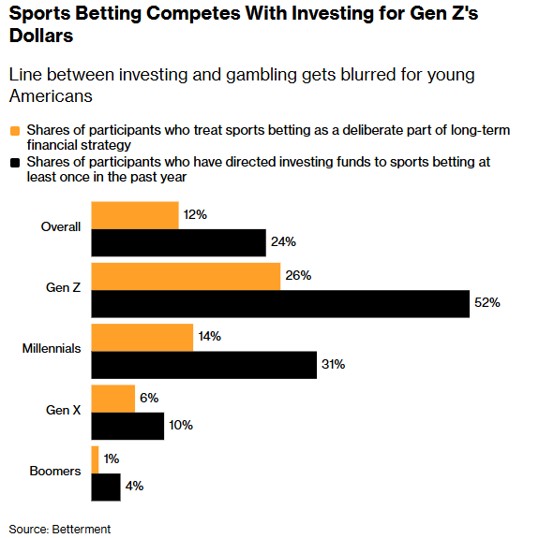
A survey by American robo-advisory platform Betterment highlights a growing shift in financial behavior among younger investors, with over a quarter (26%) of Gen Z respondents viewing sports betting as a deliberate component of their long-term wealth strategy rather than simple entertainment.
The study reveals a blurring boundary between high-risk trading and sports gambling among younger demographics. Over 52% of Gen Z participants reported reallocating funds initially intended for traditional stock investments into sports wagers over the past year. In contrast, older generations exhibit much lower participation rates, with only 14% of Millennials and 6% of Gen X viewing sports betting as a long-term investment tool.
Financial experts attribute this trend to the gamification of mobile trading apps, the widespread legalization of sports gambling platforms, and a desire for immediate returns amid global inflationary pressures. However, wealth managers warn that substituting sports betting for traditional equity portfolios carries significant capital risk, as sports outcomes lack compound interest mechanics and inherent asset value, ultimately threatening long-term retirement security for younger retail investors.
(2) Macao Launches 3rd Five-Year Plan Targeting Non-Gaming Sector to Reach 60% of GDP by 2030

(Photo Credit: Prisma by Dukas / Getty Images)
The Macao SAR Government unveiled its 3rd Five-Year Plan, spanning 10 chapters, 36 sections, and 35 key performance indicators. The comprehensive roadmap focuses heavily on economic diversification, outlining strategic measures for regional integration within the Guangdong-Hong Kong-Macao Greater Bay Area and long-term social welfare enhancements.
A central priority of the plan is advancing the “1+4” economic diversification model, with the explicit goal of having non-gaming industries account for approximately 60% of Macao’s Gross Domestic Product (GDP) by 2030. To support this target, Macao will focus tech innovation and industrial investments across four key domains: digital technology, biomedicine, integrated circuits, and aerospace technology—specifically nurturing niche sectors like artificial intelligence, innovative pharmaceuticals, RISC-V open-source architecture, and satellite data services.
Regarding regional development, the plan emphasizes high-quality integration with the Hengqin In-depth Cooperation Zone under the “co-consultation, co-construction, co-management, and co-sharing” framework. Additionally, Macao plans to strengthen ties with Hong Kong by streamlining cross-border movement and deepening cooperation in finance, healthcare, and tourism. On social welfare, the plan addresses population aging by expanding smart eldercare technologies, integrating healthcare with sports, and refining public housing allocation.
News Source: https://epaper.tkww.hk/a/202608/19/AP6a84c09ae4b099d2ba48de53.html
(3) Taiwan Claw Machine Operator Sentenced to 55 Days in Custody for Illegal Gambling Modifications

(Photo Credit: 巫鴻瑋 / United Daily News)
A Kaohsiung claw machine operator surnamed Hsu was sentenced to 55 days of detention and ordered to forfeit NT$3,000 in illegal gains for operating an unlicensed electronic gaming arcade. In October 2023, Hsu rented a claw machine in the Gangshan District of Kaohsiung and illegally modified it by adding a magnet mechanism and a dice table to attract customers.
Under Hsu’s modified game rules, players paid NT$20 per play to control the claw, pick up, and throw dice. Depending on the points rolled, players could win laundry pods, figures, or wet wipes. Furthermore, players who completed specific tasks could join Hsu’s private LINE group and receive direct cash transfers to their bank accounts. Following a police investigation, Hsu admitted to modifying the machine but claimed he was unaware that his actions violated local business regulations.
The Qiaotou District Court rejected his defense, clarifying that under self-service vending machine management standards, claw machines must not be modified with magnetic devices or dice games, nor can prizes be redeemed for cash. The judge ruled that these modifications transformed the machine from a legal automatic vendor into an electronic gaming device under the Electronic Game Arcades Business Regulation Act. Because Hsu operated without a valid business license, he was found guilty of illegal arcade operation.
News Source: https://today.line.me/tw/v3/article/RBq1B8Z
(4) How Singapore Tamed the Gambling Industry: Strategic Regulation, Social Safeguards, and Dynamic Growth
(Photo Credit: SCMP)
Singapore’s decision to legalize casino gambling twenty years ago has transformed the city-state into a global benchmark for casino regulation and urban integration. Rather than enforcing outright prohibition, Singapore adopted a pragmatic approach: channeling human vice into a tightly controlled, transparent economic driver.
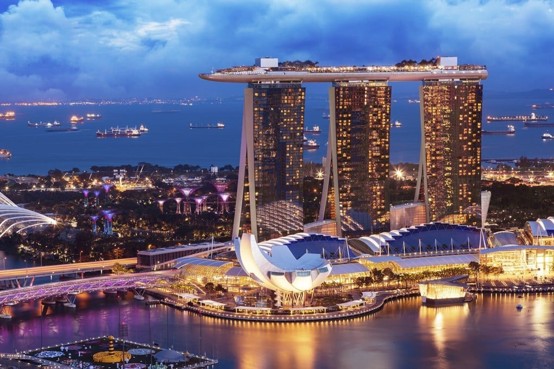
A key factor in Singapore’s success lies in its spatial design and business model. At integrated resorts like Marina Bay Sands and Resorts World Sentosa, gaming floor space constitutes less than 3% of total resort area. The remaining 97% is dedicated to luxury hospitality, convention facilities, Michelin-star dining, and family entertainment—effectively converting gambling into a high-yield tourism driver while diversifying the local economy.
To minimize domestic harm, Singapore implemented a strict dual-track system under the mantra “earn foreign revenue, protect local citizens.” Foreign tourists enter freely, while Singaporean citizens and permanent residents must pay high daily or annual entrance levies—funds directed entirely toward public welfare. Furthermore, low-income citizens, individuals receiving government aid, and bankrupt individuals are legally barred from entry. Coupled with a tiered tax structure—low taxes on high-net-worth VIP gamblers to attract international wealth and high taxes on mass-market betting—Singapore maintains a robust financial model without allowing gambling revenue to dominate national GDP.