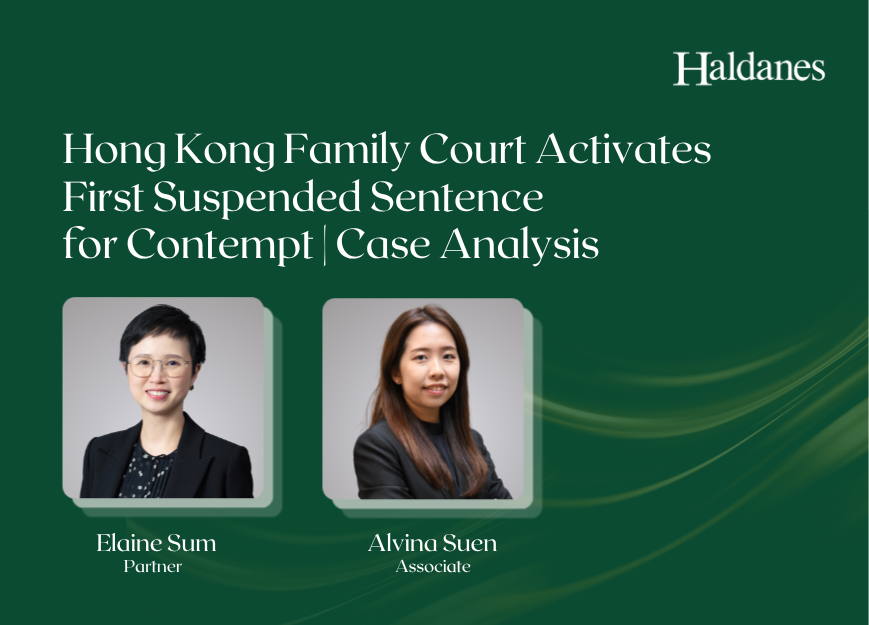
Hong Kong Family Court Activates First Suspended Sentence for Contempt | Case Analysis
Hong Kong’s family court has, for the first time, activated a suspended sentence, a decisive move underscoring the seriousness of contempt of court and the severe consequences of breaching undertakings made to the court. In this article, we summarise the case background, the key principles and the court’s decision, as well as some key takeaways.
Background
The Respondent, a qualified solicitor, had earlier received a three‑month suspended sentence for breaching a non‑molestation order. Within two months of the suspension order, she published over 100 offending online posts targeting the Applicant’s family and legal representatives, in clear breach of her non-molestation undertaking underpinning the suspended sentence. The Applicant applied to activate the suspended sentence.
Subsequently, the relevant posts were deleted after the Respondent made an application for activating the suspended sentence. The Respondent, who bears the burden of proof of the defence, opposed the above application purportedly claiming that she did not publish the posts and that her social media accounts were hacked.
Key Principles & Court’s Decision
The standard of proof for determining whether a condition attached to a suspended sentence has been breached is the civil standard of balance of probabilities rather than the criminal standard of beyond all reasonable doubt[1]. The Court has a wide discretion to decide what is just in all the circumstances. The factors for consideration include but are not limited to the severity of the breach, the person’s conduct since the sentence, and the interests of justice.
Once the burden is satisfied, the next step is to decide the appropriate order as activation of the original sentence is not automatic.
In this case, the Court rejected the Respondent’s explanation as highly improbable, noting the specificity of the leaked personal data and her failure to take basic security precautions. The Court emphasised that deletion of posts does not negate liability where other indicators point to authorship.
The Court also dismissed the Respondent’s argument that she was being “reverse‑discriminated” due to her status as a solicitor, finding the contention irrelevant and untenable.
Citing the Respondent’s unremorseful and unrepentant conduct and opportunities and indulgences previously afforded to the Respondent, the Court concluded that the Applicant had satisfied the civil standard of balance of probabilities to establish that the Respondent blatantly breached the condition attached to the suspended sentence. Therefore, the Court decided to lift the previous suspension order and ordered the Respondent to serve a three-month sentence immediately. This decision reinforces that suspended committal orders are enforceable deterrents, rather than symbolic warnings. Costs were awarded to the Applicant on an indemnity basis, reflecting the Court’s stance on compliance and accountability.
This case underscores the importance of the need to strictly abide by Court orders and undertakings to avoid adverse consequences. As the Court said,
“The wilful disobedience of a court order is a serious matter that strikes at the heart of our legal system.”[2]
Child Arrangements: Departure from the Social Investigation Report (“SIR”)
At the time of the activation of suspended sentence, the parties had shared care and control of their child, with a pending trial of the Respondent’s application for variation of custody and care and control and the Applicant’s cross application triggered by the same. As a result of the Respondent’s imprisonment, the Court varied the previous order and granted the Applicant interim sole care and control of the child in the child’s best interest.
Subsequently at the variation trial, the Respondent conceded sole care and control to the Applicant following the SIR. However, the parties contested custody. The Respondent deviated from her application for sole custody and sought to retain the joint custody order. On the contrary, the Applicant sought a variation of the joint custody order to sole custody to be vested in him primarily on the ground that the Respondent’s entrenched irrationality rendered joint decision-making unworkable.
The Court recognised the high level of tensions and accepted that while it would be ideal for the family child to be raised by the parents jointly, the ongoing parental conflicts, the parties’ emotional baggage and the dynamics of their relationship meant that joint custody would likely cause more harm than good. In addition, the Court was of the view that maintaining joint custody would merely invite a recurrence of the very dysfunction the litigation seeks to resolve.
Accordingly, even though the SIR recommended that joint custody be maintained, the Court varied the custody order to the effect that the Applicant had the sole custody of the child and that the Respondent had supervised access with a view to assisting the Respondent in adjusting her parenting style to cater for the needs and expectations of the child.
Key Takeaways
-
Will the Hong Kong Family Court activate a suspended sentence if a court order is breached?
The Family Court is ready to activate a suspended sentence in the event of a contemnor who wilfully disregards a condition attached thereto and disobeys a court order.
-
What standard of proof is required to activate a suspended sentence in family law cases?
Even though activating a suspended sentence will lead to imprisonment, the court is not required to apply the criminal standard beyond all reasonable doubt. Rather, the civil standard of balance of probabilities will be applicable.
-
Can the Family Court override a Social Investigation Report (SIR) recommendation for child custody?
In order to safeguard the best interest of a child, the court will not hesitate to depart from the recommendations made in a social investigation report and will make robust orders. Circumstances such as dysfunctional parental dynamics will not be allowed to compromise the integrity of child arrangements. Notwithstanding that, the social work officers remain the “eyes and ears” of the court and the court will only deviate from their recommendations when circumstances demand a departure.
Written by Elaine Sum, Partner, and Alvina Suen, Associate of Haldanes, Hong Kong.
About our Matrimonial & Family Law practice
Haldanes is widely recognised as a pre-eminent leader in Matrimonial & Family Law by top legal directories and publications, including Asian Legal Business, Benchmark Litigation, Chambers and Partners, China Business Law Journal, Doyle’s Guide, and Legal 500. Our practice excels in navigating intricate, high-stakes matters—from sensitive international child abduction cases under the Hague Convention to complex asset structures, pre- and post-nuptial agreements, and private wealth advisory mandates. Fully supported by our firm’s other specialist teams to provide end-to-end legal solutions across global jurisdictions, our team is also highly sought after beyond the courtroom; we are frequently invited to speak at Greater Bay Area and other China-based events, and remain deeply committed to community service, regularly conducting complimentary divorce law workshops in partnership with the Hong Kong Federation of Women’s Centres.
Further reading
- Haldanes Secures Band 1 in Chambers High Net Worth 2026 China rankings
- Haldanes wins Client Choice award: Benchmark Asia-Pacific Awards 2026
- Haldanes strengthens Matrimonial offering with partner hire
- 12 Frequently Asked Questions About Divorce and Family Law

 Articles