Asia Art Weekly News Bulletin – ISSUE 60 Week of 13 April 2026
(1) Is Hong Kong Back? The GRAND PRIX de Basel 2026
Hong Kong’s 2026 art season delivered strong sales and a bustling fair circuit led by global players like Art Basel, but new local initiatives highlight the tension between market-driven commerce and community-rooted creativity in a city still defining its own art identity.
(2) Art Basel Hong Kong 2026: Increased Female Curators and Intra-Asian Interaction
Art Basel Hong Kong 2026 marked a decade of growth with an Asia-led curatorial team that highlight emerging intra-Asia dialogue through Five Elements-inspired works and women curators.
(3) Tobias Berger launches new art space “Gold”: Inside Hong Kong’s Latest Cultural Space
Gold is a new experimental art salon in Wong Chuk Hang, Hong Kong, founded by Serakai Studio and led by curator Tobias Berger, which repurposes a former bank and jewelry shop into a flexible space for edgy exhibitions, performances, and inter-Asian collaborations without heavy sales pressure.
(4) University signs Memorandum of Understanding with Tokyo University of the Arts and National Center for Art Research, Japan
The University of Manchester signed a Memorandum of Understanding with Tokyo University of the Arts and Japan’s National Center for Art Research to advance creative health research, fostering UK-Japan collaborations on arts-based wellbeing initiatives tied to Greater Manchester’s global leadership in the field.
(1) Is Hong Kong Back? The GRAND PRIX de Basel 2026
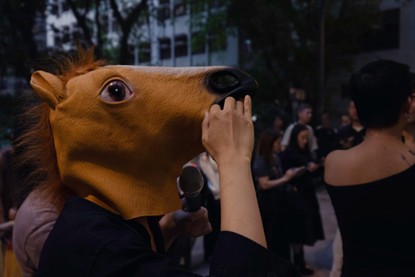
(Photo Credit: Courtesy check-in SIDE SPACE / Artasiapacific)
The art market presents art as something more than a commercial product. Buyers are encouraged to see a work of art as a piece of genius, history, or the sublime, not just an object for sale. In that sense, the market relies on a tension, that art is treated as if it is beyond ordinary pricing, while that very aura helps justify increasingly high prices.
The Hong Kong art market demonstrate this tension very clearly. Big auction houses like Sotheby’s and Christie’s arrived decades ago, in 1973 and 1986 respectively. Art Basel launched in 2013, and the M+ museum opened in 2021. The city built a huge art market first, before strong local institutions or critics. Everything runs on imported Western models, tied to finance and real estate.
In March 2026, the art season hit full speed. Art Basel Hong Kong housed 240 galleries and 91,500 visitors. Art Central showed over 100 galleries. New fairs, auctions, and 60+ gallery openings filled the city. Top sales included Liu Ye at USD3.8 million, Marlene Dumas at USD3.5 million, and a Joan Mitchell record at USD17.6 million. Auctions totaled USD 200 million, up sharply from last year. Younger artists like Jiang Cheng and Stephen Wong Chun Hei sold out.
People said “Hong Kong is back” after 2025’s slump. However, this recovery appears to benefit mainly large auction houses and major international galleries, rather than the wider artistic ecosystem as a whole. Smaller local spaces and artists still faced different commercial realities.
Against the backdrop, newer local initiatives such as Knotting Space, Pavilion, ArtHouse, and SIDE SPACE are developing more collaborative and cost-conscious models. By emphasising neighbourhood engagement, lower overheads and mixed-use spaces that combined sales with talks and community programming, they illustrated a different way of sustaining Hong Kong’s art ecosystem beyond the high-end market.
News Source: https://www.artasiapacific.com/market/is-hong-kong-back-the-grand-prix-de-basel-2026/
(2) Art Basel Hong Kong 2026: Increased Female Curators and Intra-Asian Interaction
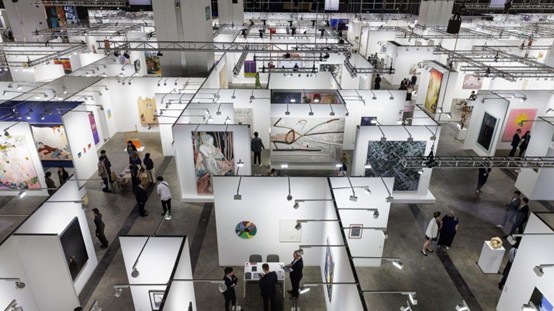
(Photo Credit:Prestige)
Art Basel Hong Kong 2026 showed a stronger connection between Asian collectors, artists, and institutions. Over half of the 240 galleries came from Asia-Pacific countries, and for the first time, the curatorial team was fully Asia-based. This marked a shift toward a deeper regional dialogue after a decade of growth in the city’s art scene.
The Encounters section featured a 12 large-scale works inspired by Asia’s Five Elements, space, water, fire, wind, and earth. Curators like Mami Kataoka from Tokyo’s Mori Art Museum, Isabella Tam from M+, Alia Swastika, and Hirokazu Tokuyama led the effort. They highlighted emerging regional voices, such as Korea’s Suki Kang with a textile installation, India’s Parag Tandel’s yarn sea sculpture, Japan’s Masaomi Yasunaga’s ceramics, and Philippines’ Geraldine Javier’s tree-like fabric columns.
The Film section, curated by Hong Kong media pioneer Ellen Pau, focused on moving images and new media. Pau, who co-founded Videotage and the Microwave Festival, praised the rise of women curators and filmmakers. She spotlighted Jen Liu’s video “The Land at the Bottom of the Sea”, a 3D animation about survival amid financial, social, and environmental collapse.
A new Echoes section displayed recent works from the last five years. Highlights include a Hong Kong’s Flowers Gallery with artists like Movanna Chen, and Capsule Shanghai with Leelee Chan. Double Q Gallery debuts with Polish artist Natalia Załuska’s cardboard paintings that mix sculpture and minimalism.
Overall, the fair brought together high-profile works, local artists, and new exhibition formats. Hong Kong had evolved into a more mature centre for the Asian art market, with stronger regional collaboration, greater visibility for women curators, and broader access for the public.
(3) Tobias Berger launches new art space “Gold”: Inside Hong Kong’s Latest Cultural Space
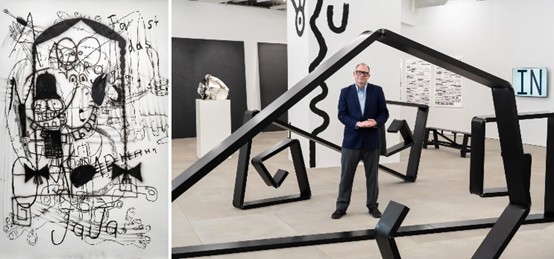
(Photo Credit: Zolima citymag)
Gold is a new art space in Wong Chuk Hang, Hong Kong, named after its past tenants: an HSBC branch and a jewelry shop for mainland tourists heading to Ocean Park. Founded by property developer Serakai Studio, with curator Tobias Berger as co-founder and director, it acts as a modern salon for exhibitions, performances, private dinners, and discussions, not focused on sales, but on ideas and experimentation.
The 3,500-square-foot ground-floor spot has a humble side-door entrance leading to white walls and high ceilings. It opens with bold works like Tozer Pak’s light-based “Using the Light of a Waning Moon to Draw a Full Moon” (2007) and Santiago Sierra’s controversial “250 cm Line Tattooed on 6 Paid People” (1999), where unemployed Cuban men were paid to get tattooed, sparking debates on exploitation versus critique.
Berger, with 20 years of experience from Para Site, M+, and Tai Kwun, sees Gold as a flexible space amid uncertainty. Hong Kong’s art scene has grown, with museums like Tai Kwun and independents like Empty Gallery building a supportive community. Gold joins this lineage, following past experiments like Spring Workshop and Things That Can Happen.
Unlike rigid institutions, Gold mixes art, design, fashion, music, and performance. Its team includes fashion curator Shirley Lau, performer Aaditya Sathish, and DJ Mildred Cheng. Upcoming shows push boundaries: the next, “Dreamcore,” blends young Chinese fashion and furniture design as half exhibition, half retail.
With a rare 10-year lease, Gold plans a Tokyo sister space to foster inter-Asian ties. Berger notes Asia’s rising art network, from Gwangju Biennale to cheaper travel, spotlighting critical talent in China and Thailand. Gold aims to be Hong Kong’s edgiest spot, contributing to a thriving, collaborative ecosystem.
News Source: https://zolimacitymag.com/tobias-berger-gold-hong-kong-cultural-space-wong-chuk-hang/
(4) University signs Memorandum of Understanding with Tokyo University of the Arts and National Center for Art Research, Japan

(Photo Credit: The University of Manchester)
The University of Manchester has signed a Memorandum of Understanding (“MoU”) with Tokyo University of the Arts (“TUA”) and Japan’s National Center for Art Research (“NCAR”) to boost interdisciplinary research on creative health. This three-way partnership focuses on knowledge exchange between the UK and Japan, building on Greater Manchester’s role as a global leader in arts and health.
Greater Manchester launched its Creative Health Strategy in 2022, aiming to become the world’s first Creative Health City Region. The GM Creative Health Place Partnership supports arts-based activities to improve wellbeing across the area. Under this MoU, the partners will collaborate with the Greater Manchester Combined Authority to strengthen international ties in research and practice.
The agreement gets signed in Tokyo on 23 May 2026, after NCAR’s Co-Creation Forum Vol.2 on museum-based wellbeing. Manchester experts will present their local initiatives there. They also speak at the Kyoto University International Social Prescribing Conference, joined by TUA and NCAR academics.
Professor Angelia Wilson from Manchester calls it a step for research excellence in creative health. She says the Tokyo meeting will spark idea-sharing and solutions. TUA’s Professor Takashi Kiriyama highlights arts’ role in fighting isolation and boosting mental and physical health. NCAR’s Senior Curator Inaniwa Sawako sees it as a chance to link research, culture, communities, health, and society through new approaches.
Manchester already partners with Asian schools like Manchester-Chinese University of Hong Kong and others in India and Bangalore. Its Faculty of Humanities co-founded the Global Humanities Alliance with universities in Australia, Canada, Africa, and Asia. The university ranks in the global top 50, with over 44,000 students and a focus on impactful research.
This deal expands creative health work, connecting universities, museums, and local governments for better global dialogue.