Asia Art Weekly News Bulletin – ISSUE 62 Week of 27 April 2026
(1) Taiwan’s National Culture and Arts Foundation Strips National Prize from Indigenous Artist Sakuliu Pavavaljung After Sexual Assault Conviction
Taiwan revoked artist Sakuliu Pavavaljung’s top arts award after his sexual assault conviction.
(2) How US painter became Hong Kong Artists Association’s first non-Chinese member
American born artist Nissa Kauppila became the first non ethnic Chinese member of the Hong Kong Artists Association, recognized for blending Chinese ink traditions with Western realism.
(3) Hong Kong’s art market resilience, proven by The Great Wave’s US$2.8 million sale
Hong Kong’s art market is cooling overall, but top works still attract strong demand. Lower priced sales remain steadier, supported by younger buyers and Hong Kong’s strengths as a regional trading hub.
(4) Singapore’s Amanda Heng on making feminist art in a country that wasn’t ready for it
Singapore artist Amanda Heng will represent the country at the 2026 Venice Biennale with a participatory pavilion exploring rest, care, feminism and community.
(1) Taiwan’s National Culture and Arts Foundation Strips National Prize from Indigenous Artist Sakuliu Pavavaljung After Sexual Assault Conviction
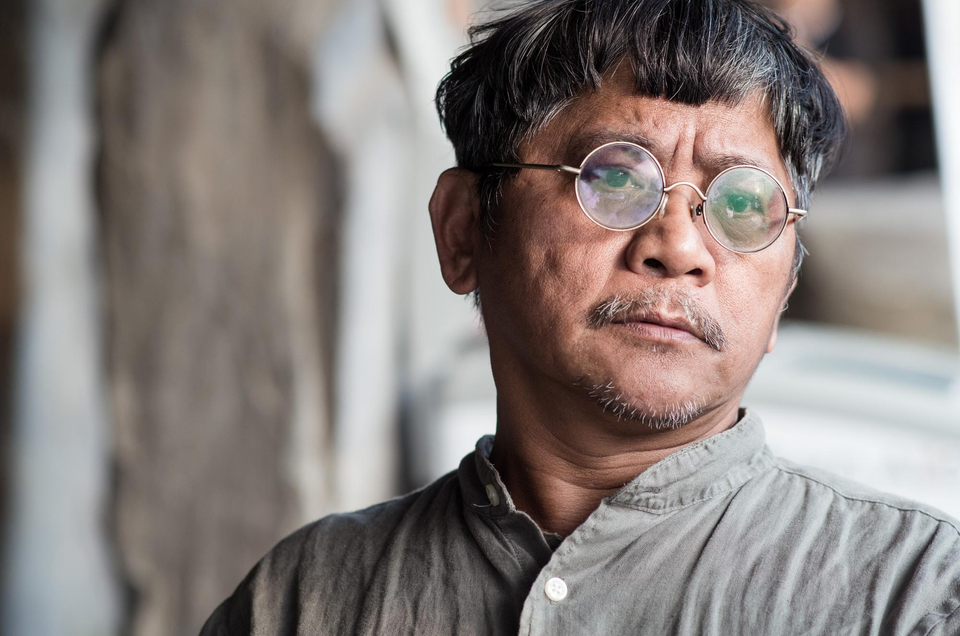
(Photo Credit: Wang Wenyan / Artasiapacific)
Taiwan’s National Culture and Arts Foundation has revoked the National Award for Arts granted to Indigenous artist Sakuliu Pavavaljung in 2018, after his conviction on sexual assault charges. The foundation also ordered him to return the NTD 1 million prize, in a rare move involving one of the country’s highest cultural honours.
In 1997, the Taiwan government run award recognizes individual achievement across artistic fields and is regarded as one of Taiwan’s most prestigious distinctions. In its 20th edition, announced in 2017 and presented in 2018, seven artists were honoured. Sakuliu Pavavaljung received the prize in visual art for multidisciplinary work shaped by Paiwan culture.
The decision followed Supreme Court ruling on 1 April 2026 that upheld his prison sentence of four years and six months for forcible sexual intercourse. The case arose from an incident in February 2021 involving a female student. Public attention intensified in December that year after artist Kuo Yu Ping revealed the case on social media, leading other alleged victims to speak out. Pavavaljung denied the accusations, but his appeals against earlier court rulings were unsuccessful.
The allegations had already reshaped his career. In 2022, his planned exhibition for Taiwan at the 59th Venice Biennale was canceled and replaced with “Impossible Dreams,” a collateral project on the region’s history in Venice. The revocation is the first use of Taiwan’s 2023 MeToo disqualification rules for a national honor.
News Source: https://www.artasiapacific.com/news/taiwan-strips-national-prize-from-sakuliu-pavavaljung-after-sexual-assault-conviction-2/
(2) How US painter became Hong Kong Artists Association’s first non-Chinese member
(Photo Credit:SCMP)
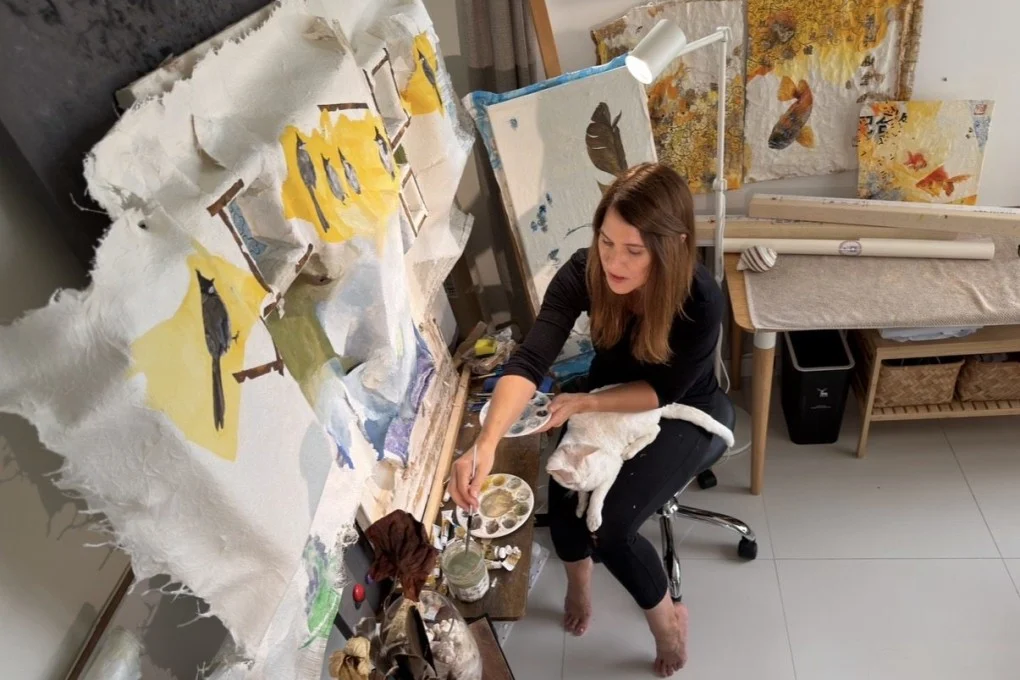
American born artist Nissa Kauppila has become the first non ethnic Chinese member of the Hong Kong Artists Association, marking a notable moment for a group dedicated to promoting traditional Chinese culture. Her admission reflects not only technical mastery, but also recognition of an artistic practice that bridges Chinese brush and ink traditions with Western realism.
Kauppila, a 43 year old resident of Lantau, grew up in rural Vermont, where a childhood shaped by birdwatching and close contact with nature laid the foundation for her art. After studying at the Rhode Island School of Design and working in education and broadcast journalism, she visited mainland China in 2014 and soon made a life changing decision to move to Foshan. There, she abandoned her familiar Western materials and committed herself to learning Chinese ink painting with the help of silk painter Lin Bo, who trained her through long, disciplined studio sessions focused on traditional brushwork.
Her work stands out for combining the philosophy and techniques of classical Chinese painting with the precise observation of a natural history illustrator. Birds, butterflies and other subjects are rendered with both lyrical atmosphere and scientific detail, giving her paintings a distinct cross cultural identity.
After relocating to Hong Kong in 2019, Kauppila’s career faced several setbacks, including the pandemic and a serious spinal injury in 2025. Yet both experiences pushed her work in new directions. Her recent series uses found objects such as fibreglass and discarded canvas collected from Hong Kong shores, pairing delicate ink imagery with debris shaped by human activity.
(3) Hong Kong’s art market resilience, proven by The Great Wave’s US$2.8 million sale
(Photo Credit: SCMP)
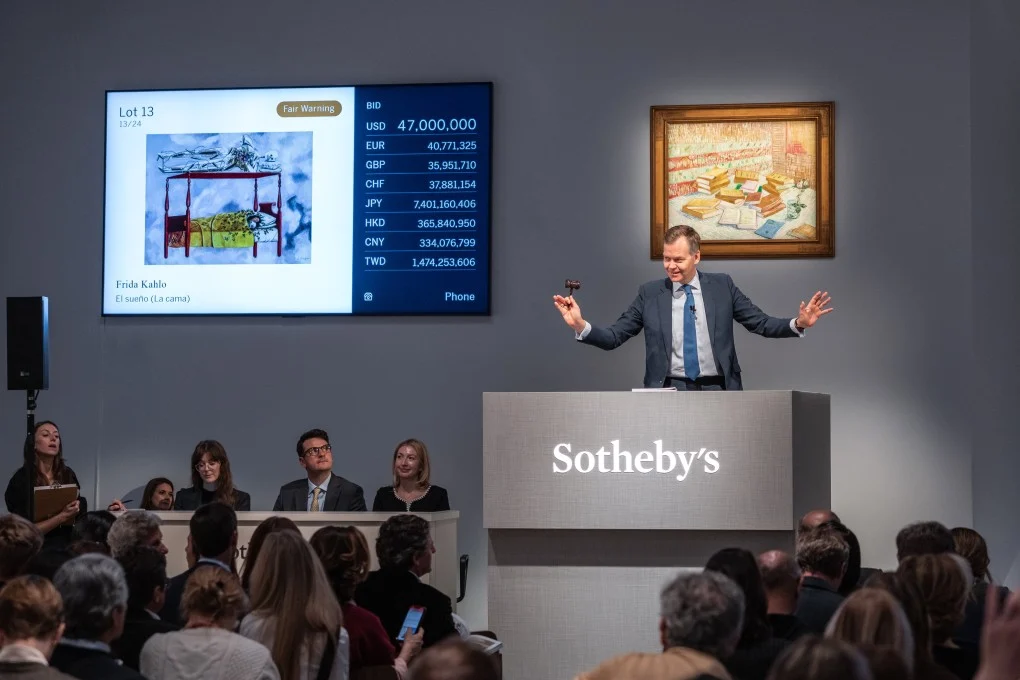
The revenue of Hong Kong’s art market is sending mixed signals. Overall sales suggest a slowdown but record breaking deals such as the US$2.8 million sale of Hokusai’s The Great Wave in November 2025 show that demand for rare, top tier works remains strong.
That contrast has made the market harder to read. Works priced above US$1 million still account for most of the value at auction, even though they make up only a small share of lots sold. As fewer museum quality pieces come to market, headline sales totals have fallen sharply, exposing how dependent the trade has become on a narrow band of ultra high value consignments. Reports by Art Basel and UBS, along with ArtTactic’s China market analysis, show that global and Greater China sales both declined in 2024 as geopolitical uncertainty, high interest rates and tighter liquidity made wealthy collectors more cautious.
Yet the market has not stalled. Transaction volumes have held up better than values, especially at lower price points. In Hong Kong and mainland China, works below US$50,000 have remained comparatively resilient, supported in part by younger millennial and Gen Z buyers who are more open to emerging artists. Dealers in Hong Kong describe conditions as steady rather than exuberant. While the top end has cooled, the city remains Asia’s leading art trading hub, supported by its tax advantages, auction infrastructure and links to mainland capital.
News Source: https://www.scmp.com/special-reports/article/3351635/hong-kongs-art-market-resilience-proven-great-waves-us28-million-sale?pgtype=live
(4) Singapore’s Amanda Heng on making feminist art in a country that wasn’t ready for it
(Photo Credit: Instagram / rhondapryor10)
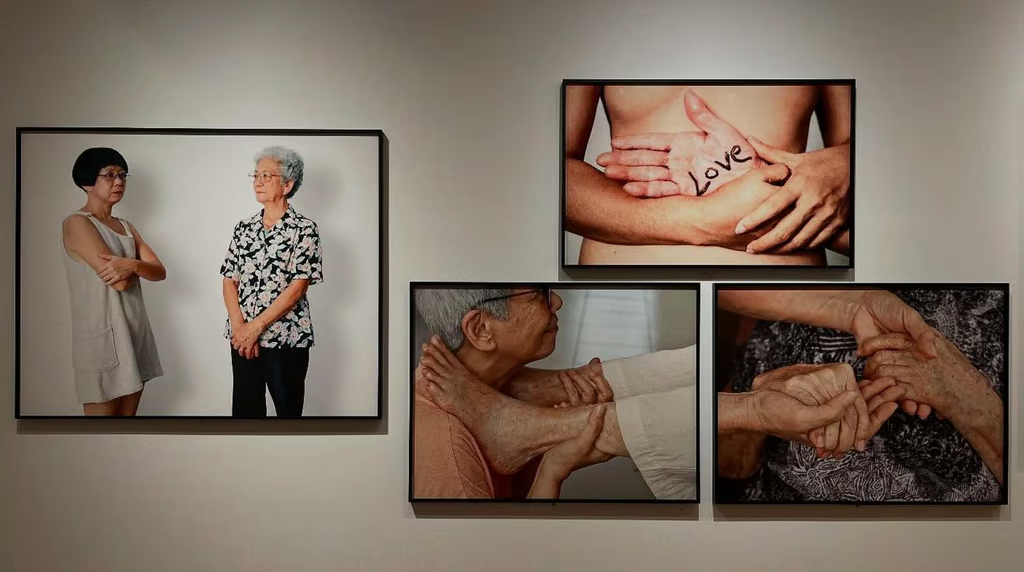
Singaporean artist Amanda Heng Liang Ngim has spent decades turning everyday acts into shared performances that challenge social norms and invite public reflection. She is now 74 years old while she will represent Singapore at the 2026 Venice Biennale with A Pause, an installation that transforms the Singapore Pavilion into a space for rest, reflection and spontaneous human connection.
Heng is widely regarded as one of Singapore’s most important feminist artists. Since the late 1980s, she has used performance, photography and installation to confront gender inequality, question beauty standards and examine the effects of rapid modernisation. Her work often grows out of personal memory, especially her childhood in a kampong, where communal living shaped her belief in doing things together rather than alone.
She also helped shape Singapore’s contemporary art scene beyond her own practice. Heng co-founded The Artists Village in 1988 and later established Women in the Arts, helping create space for performance and socially engaged art at a time of limited institutional support. Her art has remained grounded in quiet but persistent gestures, from walking and waiting to peeling bean sprouts and talking with strangers.
The Venice presentation continues that approach while drawing on more recent reflections on ageing, care and rest. Developed in part through work connected to her mother and her experience of palliative care, A Pause asks visitors to slow down in a world defined by speed and productivity. For Heng, the exhibition is both personal and political, and a continuation of the same questions that have guided her for more than 40 years.