Haldanes’ Insights: Criminalising Bid-Rigging – 5 Features of Competition Commission’s Reform
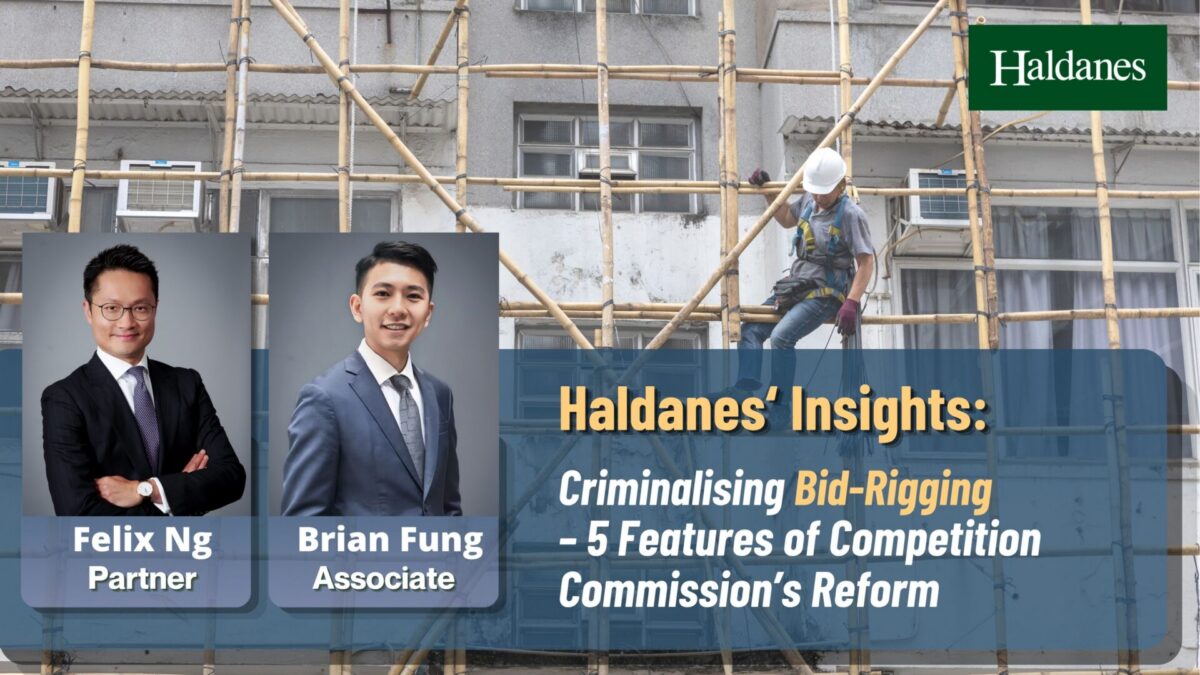
In the wake of the tragic fire at Wang Fuk Court in Tai Po and the criminal investigations and public inquiry that followed, the Competition Commission of Hong Kong has recently proposed criminalising bid-rigging to strengthen the current antitrust regulatory regime and heighten its scrutiny over serious cartel conduct. According to the Commission, the proposed framework will empower the competition watchdog to combat serious anti-competitive conduct (especially bid-rigging) either through civil proceedings or criminal prosecutions and the maximum imprisonment terms will be as high as 7 to 10 years. The Commission plans to submit its formal proposal by September 2026, targeting a Legislative Council amendment bill by the second quarter of 2027.
Competition Commission’s Proposed Reform
We summarise below the salient features of the Commission’s tentative proposal which will likely have far-reaching ramifications not only on its enforcement powers but also the related investigation procedures and court proceedings:
1. “Dual-Track” civil and criminal regimes
Under the present Competition Ordinance (Cap 619) framework, the Competition Commission lacks criminal prosecutorial powers – it can only investigate anti-competitive behaviours under the First and Second Conduct Rules and seek financial penalties and other civil sanctions such as disqualification orders before the Competition Tribunal, which carries no criminal liability.
The Commission explained that under the proposed “Dual-Track” enforcement regime, it could elect to instigate criminal prosecutions against bid-riggers if (i) there is compelling evidence against wrongdoers and (ii) the case concerns substantial public interest. For less serious cases, the option of pursuing civil proceedings remains open to the regulator.
We envisage that this proposed regime will be akin to the dual civil and criminal regime under the Securities and Futures Ordinance (SFO; Cap 571), whereby the Securities and Futures Commission (SFC) is vested with powers to investigate market misconduct cases and pursue civil proceedings before the Market Misconduct Tribunal (MMT) or commence criminal prosecutions in the criminal courts. We also anticipate a significant overhaul of the competition investigation procedures, including the potential introduction of a protection mechanism concerning privilege against self-incrimination under Section 187 of SFO.
2. Deterrent Imprisonment Terms – the Commission intends to introduce deterrent imprisonment sentence with a maximum of 7 (or even up to 10) years.
3. Enhancement of Fines – fines may be enhanced to HK$5 million or even HK$15 million, or alternatively, as a percentage of the crime proceeds obtained.
4. Burden of Proof – the prevailing standard of proof in enforcement proceedings before the Competition Tribunal is the criminal standard of “beyond reasonable doubt” (which has been consistently applied since the landmark case of Nutanix). The Commission seeks to lower it to the civil standard of “balance of probabilities”.
5. Stopgap Measures in Combating Collusion
As an immediate stopgap measure against collusive conduct, the Commission has also introduced enhanced “Non-Collusion Clauses” (NCC) and a mandatory Statutory Declaration requirement (*see the Hong Kong Competition Commission press release). The NCC contains unequivocal terms that bidders who collude after signing the “Non-Collusive Tendering Certificate” could face common law charges of Conspiracy to Defraud, carrying up to 14 years’ imprisonment upon conviction.
This enhanced version also introduces a new requirement for bidders to submit a Statutory Declaration (which could only be made before Commissioner for Oaths or other legally authorised persons) to procurers affirming their independence and non-collusion. The significance of this is that any person who makes a false representation will be liable to a stand-alone criminal offence “Making a False Statutory Declaration” under Section 36 of the Crimes Ordinance (Cap 200) which carries a maximum penalty of two years’ imprisonment and a fine.
We believe that the above measures could dispense with the need for the regulators to prove conspiracy, dishonesty or economic loss, making criminal prosecutions more straightforward and preventing wrongdoers from evading liability if they make false declarations.
The exact details of how the Commission intends to overhaul the entire antitrust enforcement regime remain to be seen. What is certain is that competition law has now become a matter of significant public interest and the proposed reforms will have a profound impact on the Hong Kong antitrust enforcement landscape for the years to come.
Competition Commission’s Enforcement against Bid-rigging
Bid-rigging among competitors is considered a “serious anticompetitive conduct” under the First Conduct Rule and is one of the major investigation focus of the Competition Commission since the Competition Ordinance came into force in December 2015. There have been notable Competition Tribunal enforcement proceedings involving bid-rigging, price-fixing and market sharing in various public housing and building maintenance projects over the past decade (including CTEA 1/2026 this year). The ICAC and the Hong Kong Police Force have also joined forces with the Competition Commission to combat such malpractices, including “Operation Janus” in September 2025.
Haldanes’ Antitrust and Competition Law practice
Backed by five decades of exceptional experience in criminal defence and regulatory investigations, Haldanes’ Antitrust and Competition Law practice possesses a distinct strategic advantage in managing the uniquely quasi-criminal nature of Hong Kong’s antitrust enforcement regime.
As a three-time winner in the Competition and Antitrust category at the China Business Law Journal’s China Business Law Awards and a key contributor to the World Bank’s Business Ready 2025 Report, our legal insights are frequently sought after by major international media outlets ranging from Reuters to the South China Morning Post.
We were also recently selected for the 2026 “Go Global” panel (Antitrust & Competition category) — a joint initiative between the Department of Justice and the Hong Kong Trade Development Council aimed at connecting mainland Chinese enterprises with Hong Kong’s elite legal sector.
Haldanes’ Criminal Defence Practice
Haldanes is the best-known criminal law firm in Hong Kong. We have a sizeable Criminal Defence Department and our award-winning team has been consistently recognised by leading international legal directories, including Asian Legal Business, Who’s Who Legal / Lexology, Legal 500, Benchmark Litigation, Doyles’ Guide, Mondaq, and China Business Law Journal.
Further Reading:
- SCMP Interviews Felix Ng on Criminal & Antitrust Issues After Tai Po Fire
- Haldanes interviewed by SCMP on ParknShop-Wellcome supermarket merger
- The World Bank’s Business Ready 2025 Report
- Partner Felix Ng interviewed by Reuters on CK Hutchison’s Panama ports deal
- Competition Law in Hong Kong: 9 Things You Need to Know
 Articles