Asia Gaming Weekly News Bulletin – ISSUE 79 Week of 24 August 2026
(1) Hong Kong Jockey Club phases out Electronic Shroff Card at off-course betting branches
The Hong Kong Jockey Club is discontinuing its long-standing Electronic Shroff Card in stages at off-course betting branches, citing the success of its digital platforms and the very low remaining usage of the physical card.
(2) South Korea blocks prediction market Polymarket as illegal gambling
South Korea’s Korea Communications Standards Commission has ordered the blocking of the overseas prediction market Polymarket, classifying it as an unlicensed gambling website.
(3) Hong Kong moves to regulate claw machines and pinball machines over gambling elements
Hong Kong authorities are introducing tighter licensing rules for claw machines and pinball machines venues after concluding that certain prize-redemption practices contain gambling elements and carry addiction risks.
(4) Over 100 people referred to prosecution in Vietnam-based illegal gambling site bust
South Korean police have referred more than 100 people to prosecutors over their alleged involvement in a Vietnam-based illegal online gambling operation that handled approximately 63 billion won (US$45.6 million) in bets.
(1) Hong Kong Jockey Club phases out Electronic Shroff Card at off-course betting branches
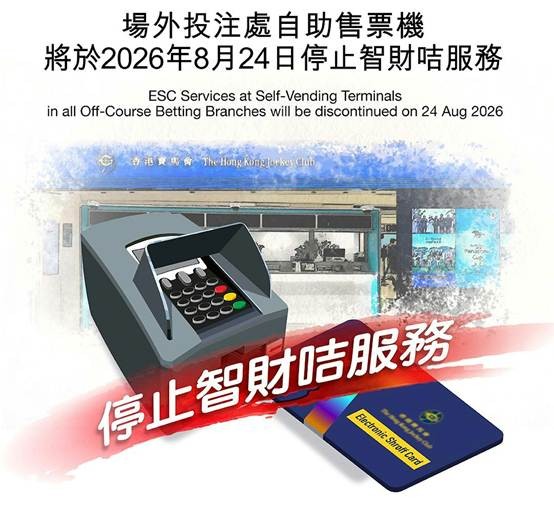
(Photo Credit: HK01)
First introduced in 1995, the Electronic Shroff Card (ESC), commonly known as the Smart Card, enabled customers to link their betting accounts for horse racing, football and Mark Six transactions. It was widely used at both racecourses and off-course betting branches for self-service betting and cash transfers during an era when electronic and online channels were less developed.
With the widespread adoption of the “HKJC Classic 3-in-1” application and digital wallet services, the Club observed that only a very small number of customers continue to rely on the physical card. As part of its ongoing digital transformation strategy, the Jockey Club decided to phase out the service at off-course locations while assisting remaining users to migrate to electronic alternatives.
Self-service terminals at off-course betting branches will cease accepting the Smart Card from 24 August 2026. Counter support for the card will continue on a limited basis until the end of 2026 and will be fully withdrawn from 2027 onwards. The card will remain operational at Sha Tin and Happy Valley racecourses.
Cardholders who wish to discontinue the service may present the Smart Card together with their Hong Kong identity card at any off-course betting branch counter to reclaim the HK$20 deposit. Once the refund is processed, the card will be retained by Club staff.
(2) South Korea blocks prediction market Polymarket as illegal gambling

(Photo Credit: Exmoo News)
Polymarket allows users to trade event contracts denominated in cryptocurrency stablecoins, with prices fluctuating according to the market’s collective assessment of the probability of political, economic or sporting outcomes. Supporters of such platforms often describe them as information markets, while regulators focus on the fact that participants risk real money on results.
After initiating a review in May 2026, the Korea Communications Standards Commission examined overseas regulatory approaches as well as the platform’s provision of Korean-language services and its accessibility to South Korean users. The Commission concluded that the activity constitutes illegal gambling because it has not obtained a local gambling licence.
Under the decision, internet service providers in South Korea will restrict access to the relevant domains. While domain blocking raises the barrier to entry, it may not completely prevent users from reaching the site through virtual private networks or other technical means.
The ruling marks a shift from preliminary assessment to active enforcement and reflects broader regional scrutiny of prediction markets. Authorities may also monitor related promotion, payment channels and cryptocurrency flows in the future, as jurisdictions continue to differ in their classification of such platforms as gambling, financial products or information tools.
News Source: https://www.exmoo.com/article/264525.html
(3) Hong Kong moves to regulate claw machines and pinball machines over gambling elements

(Photo Credit: China Times)
The rapid expansion of claw-machine and pinball-machine amusement venues across Hong Kong has prompted official concern. At a meeting of the Legislative Council Panel on Home Affairs, Culture and Sports, Secretary for Home and Youth Affairs Alice Mak stated that certain operating models involve gambling elements and pose risks of addiction, particularly among younger users.
Under the proposed framework, each device will be required to obtain an Amusements with Prizes Licence. Operators will also be obliged to display the licence at venue entrances and to post addiction-warning signage. Licensing fees, which have remained unchanged since 2000, are under review.
Key operational restrictions under consideration include a maximum play fee of HK$5 per attempt and a prize-value limit of HK$300. The authorities further intend to prohibit the practice of returning balls, tokens or similar items as rewards that allow players to continue gaming, a model viewed as effectively converting the activity into a form of gambling.
The measures aim to bring the sector under clearer regulatory oversight and to curb unlicensed prize-redemption schemes. Comparable prize-value and fee caps already exist in several other Asian jurisdictions, reflecting a regional trend towards tighter control of amusement devices that blur the line between entertainment and gambling.
News Source: https://www.chinatimes.com/realtimenews/20260822000002-260402?chdtv
(4) Over 100 people referred to prosecution in Vietnam-based illegal gambling site bust

(Photo Credit: Yonhap News)
The Chungbuk Provincial Police Agency announced that it sent 13 site operators, including a ringleader in his 30s, and 105 heavy users of the website to the prosecution without physical detention on gambling-related charges. The platform offered illegal sports betting and other gambling services targeting Korean users.
According to investigators, the gambling ring established an office in Vietnam in April 2024 and operated the site for about 10 months. The website attracted a total of 3,553 members, of whom police identified 105 individuals who had placed particularly large bets and referred them for prosecution.
The investigation began after police received a tip and examined transaction records linked to more than 200 bank accounts. Charges include operating an illegal gambling venue and violations of the National Sports Promotion Act.
Police stated that one other ringleader remains at large and is believed to have fled overseas. Further investigation is continuing, with authorities pursuing international cooperation to locate the fugitive.
News Source: https://en.yna.co.kr/view/AEN20260825005200315