China Media and Entertainment Weekly News Bulletin – ISSUE 109 Week of 13 July 2026
(1) AI and Financial Downturn Reshape China’s Entertainment Industry
Top Chinese actors are publicly pleading for work due to a severe entertainment industry downturn. Box office revenues have sharply declined, and streaming platforms have halved new show productions. Concurrently, artificial intelligence has replaced ninety-five percent of micro-dramas, leaving an estimated eighty percent of traditional actors facing potential unemployment.
(2) AI Shift Triggers Sudden Cancellation for Top Short Drama Star Wang Xiaoyi
Top Chinese short-form drama actress Wang Xiaoyi abruptly canceled her upcoming series due to “unforeseen circumstances”. Industry experts link the cancellation to investors pulling funds from live-action projects to favor artificial intelligence. The sudden shift has divided digital viewers, with many protesting automated media over traditional performances.
(3) Singer Jay Fung Debuts All-English Album with Live Hong Kong Performance
Hong Kong singer-songwriter Jay Fung released his debut all-English album, Another Shade of Blue, and celebrated with a live performance for one thousand fans. Despite the challenges of producing non-Cantonese music in Hong Kong, strong audience support has prompted his label to announce an upcoming colored vinyl release.
(4) Pop Giants Grasshopper and Mayday Deliver Historic Joint Performance in Taipei
Hong Kong pop trio Grasshopper and Taiwanese rock band Mayday united for a historic joint performance at the Taipei Dome. The iconic groups performed a mashup of classic hits before more than forty-five thousand fans. Grasshopper also announced an upcoming concert at the Taipei Arena scheduled for January 2027.
(5) Stephen Chow’s Kung Fu Female Soccer Shatters Records with 200 Million Yuan Opening
Stephen Chow’s new film Kung Fu Female Soccer has shattered box office records in China. It earned over 200 million yuan on its first day and was filmed entirely in Shenzhen. This success highlights the city’s rising role in the national entertainment industry.
(6) Proposals Urge Movie-Themed “Studio City” and Better Integration in Hong Kong
A prominent political party in Hong Kong has proposed building a major film-themed studio city to boost the local entertainment sector. This proposal aims to revive Hong Kong’s rich cinematic heritage. It also suggests new travel passes to make regional commute easier for creative talent.
(7) China Promotes Digital Upgrades to Transform Traditional Movie Theaters
China’s film authorities have launched new policies to transform traditional movie theaters into vibrant cultural venues. In response, a flagship virtual reality cinema in Beijing is combining films with interactive technology and cultural events to create a new immersive entertainment experience.
(8) China’s Live-Action Mini-Drama Market Cools Rapidly Under Tightening Regulations
China’s live-action micro-drama industry is facing a sharp downturn despite a six-billion-yuan government and platform support package. Leading production companies are freezing projects, and new releases have plummeted by over ninety percent this year. Investors are withdrawing as the market shifts toward higher production costs and AI alternatives.
(9) China Approves First Fully AI-Generated Feature Film Under Tight Tech Regulations
China has approved its first fully AI-generated feature film for public release. “Hot-blooded Dachen Island” tells the true story of early settlers reclaiming a rugged local island. The movie is scheduled to debut in early August and marks a major technological milestone for the industry.
(10) Kpop girl group TWICE’s Tzuyu Rumored to Leave JYP for Family-Owned Taiwanese Agency
Taiwanese singer Tzuyu, a member of the South Korean group TWICE, is rumored to be leaving her agency, JYP Entertainment. Local media report she may launch her solo career in Taiwan under a new agency established by her parents, although neither side has confirmed the news.
Three members of the Hong Kong girl group COLLAR attracted hundreds of fans to the Hong Kong Book Fair for a photo book signing event on July 15. The chaotic turnout highlights the growing trend of pop idols dominating literary spaces, shifting the traditional cultural focus of the annual fair toward commercial celebrity promotion.
(12) Chinese Film Studios Pivot to Immersive Tourism to Counter AI Disruptions
China’s traditional filming bases are pivoting to immersive tourism to survive a severe drop in live-action productions. The rise of artificial intelligence has heavily disrupted the micro-drama industry, forcing these studio hubs to offer interactive acting experiences and live performances directly to visiting tourists.
(1) AI and Financial Downturn Reshape China’s Entertainment Industry
(Photo Credit: Weibo)
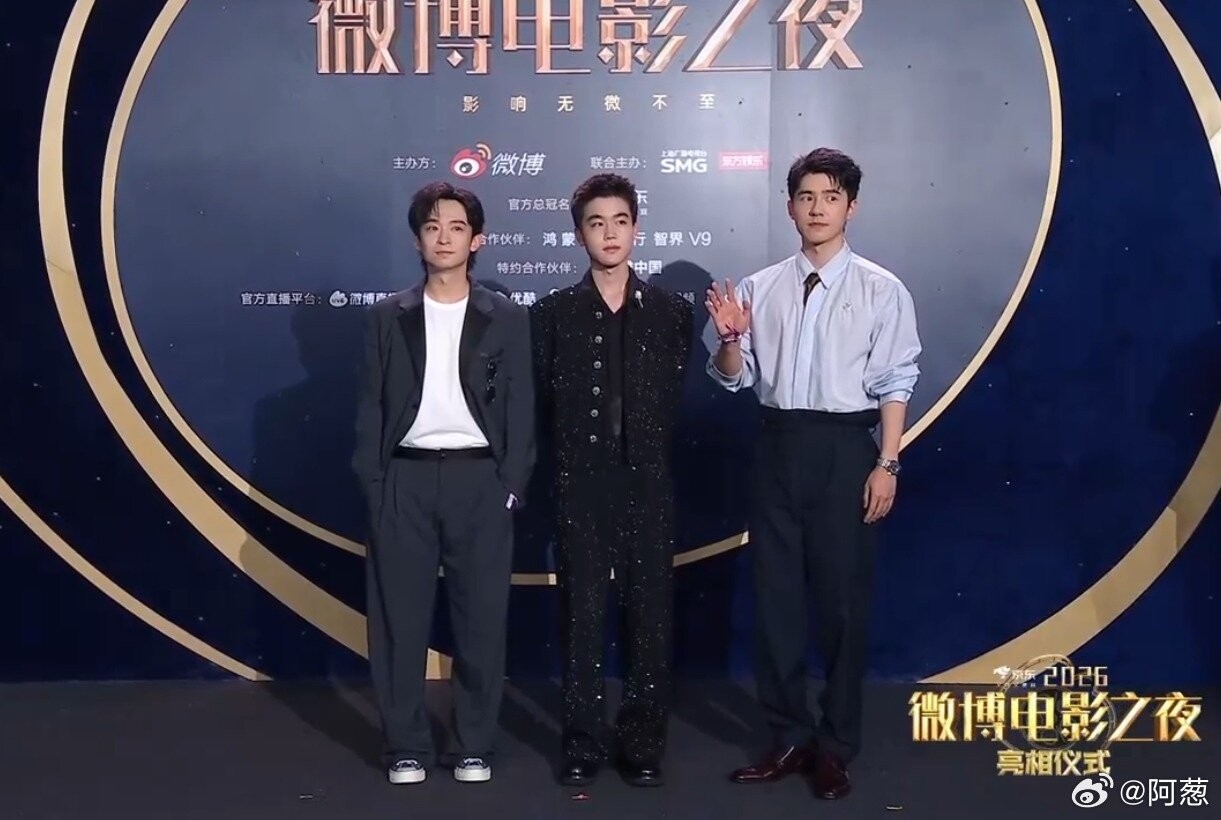
China’s entertainment sector is experiencing a severe economic downturn, leaving even top-tier celebrities publicly pleading for work. At the recent Weibo Movie Night, prominent actors Dong Zijian, Liu Haoran, and Cheng Xiao openly asked directors for employment during their red-carpet interviews and acceptance speeches. These public requests reflect a broader, alarming trend across the domestic entertainment market. Project volumes are shrinking rapidly, and traditional fan-maintained tracking charts show that several mainstream stars have now gone hundreds of days without entering a filming set.
This widespread talent anxiety stems from a drastic reduction in total entertainment production. China’s annual box office has suffered a steep decline, falling from over twenty-eight billion yuan in early 2025 to just sixteen billion yuan in the same period of 2026. Because high-budget films are no longer guaranteeing financial success, investors are becoming risk-averse and capping project budgets. Concurrently, major video streaming networks halved their long-form drama productions in the first quarter of 2026 compared to two years prior.
The crisis is particularly acute at the famous Hengdian World Studios, which has reportedly transformed from a bustling production hub into a ghost town. Artificial intelligence has swiftly taken over the low-budget micro-drama sector, accounting for over ninety-five percent of the 128,000 short series launched in early 2026. By lowering production costs to a fraction of live-action budgets, digital software has caused live short-form filming to plummet by seventy-five percent. Furthermore, production companies are buying up the digital portrait rights of background actors to train automated systems. Industry analysts warn that these technological shifts, combined with tighter capital, could leave eighty percent of traditional Chinese actors facing immediate unemployment.
News Source: World Journal
(2) AI Shift Triggers Sudden Cancellation for Top Short Drama Star Wang Xiaoyi

(Photo Credit: Weibo)
Wang Xiaoyi, one of China’s most popular short-form drama actresses, has sparked intense online discussion after her management studio abruptly canceled an upcoming filming project. Wang is widely recognized as a top-tier digital star in the micro-drama industry, with hit web series like Xun Ye (馴野) and A Family of Three in the Same Class (一家三口在同班) drawing billions of collective views. Her agency had originally scheduled a high-profile production launch for mid-July, but executives released a sudden public statement citing force majeure as the reason for halting the project entirely.
Media analysts point out that these abrupt cancellations usually stem from sudden shifts in investor financing, a problem that is increasingly plaguing traditional actors. Another prominent micro-drama actress, Han Yutong, recently suffered consecutive production cancellations for similar financial reasons. Furthermore, Tinghuadao, a leading domestic short-drama production studio, reportedly plans to downscale its live-action filming schedule to reallocate corporate resources toward artificial intelligence creation. Consequently, the studio chose not to release any promotional itineraries for its signed talent roster this month.
The industry overhaul has sparked a heated debate among domestic entertainment consumers regarding the value of human performance. Many traditional fans expressed disappointment over the cancellation, arguing that automated software cannot replicate the genuine emotional nuance and vulnerability of a human actor. Conversely, tech-oriented viewers note that automated animated series and digital look-alikes are already dominating regional streaming charts. This strategic migration toward automation reflects a broader structural adjustment within China’s entertainment ecosystem, where major platforms are prioritizing low cost and high efficiency over conventional talent management.
News Source: FTNN
(3) Singer Jay Fung Debuts All-English Album with Live Hong Kong Performance

(Photo Credit: Wenweipo)
Hong Kong singer-songwriter Jay Fung recently celebrated the launch of his first all-English studio album, Another Shade of Blue, by hosting an intimate live music showcase at the Tides venue in Whampoa. The popular artist performed a curated setlist featuring every track from the new record alongside several personal favorite cover songs for a crowd of nearly one thousand attendees. Playing acoustic guitar, Fung easily transitioned from emotional ballads to upbeat tracks while actively interacting with the audience.
The standing-room-only event drew a notable crowd of regional figures. High-profile attendees included French singer-songwriter Joyce Jonathan, local pop artist Leung Chiu-fung, and rising Cantopop singer Cloud Wan. Fung expressed immense gratitude to his production team and his twin brother Tim, who co-wrote several tracks on the album. During his performance, Fung acknowledged the historic financial and promotional difficulties of releasing non-Cantonese music within the traditional Hong Kong market. He thanked his record label and his fan base for enabling him to realize his long-held dream of creating an English-language project.
Following the showcase, Fung admitted to reporters that he felt significantly more pressure delivering an English performance compared to his usual Cantonese concerts. He explained that his artistic standards were exceptionally high for his first English showcase, though he felt satisfied with the audience engagement. To conclude the evening, Fung rewarded the positive crowd reception by announcing that the record company will soon press a special colored vinyl edition of the album. The successful launch highlights a growing appetite for diverse, multilingual music formats within the industry.
News Source: Wenweipo
(4) Pop Giants Grasshopper and Mayday Deliver Historic Joint Performance in Taipei

(Photo Credit: HK01)
Two of the most enduring acts in the Mandopop and Cantopop worlds officially joined forces last Sunday as Hong Kong veteran trio Grasshopper made a surprise appearance at Mayday’s landmark “5525” anniversary concert. Performing in front of over 45,000 fans at the Taipei Dome, the two iconic bands delivered a high-energy collaboration that delighted multiple generations of music lovers.
The artists performed a mashup of their respective signature hits, including Grasshopper’s high-octane dance track “Blame it on the Samba” (忘情森巴舞) and Mayday’s rock anthem “Party Animal” (派對動物). Despite sharing a record label in the 1990s, the musicians had never officially shared a stage. Members of both groups expressed their excitement over the milestone, joking about forming new sub-units based on their matching long hair and silver hairstyles.
Behind the scenes, Grasshopper’s Calvin Choy admitted to a minor regret. In the excitement of the performance, he forgot to ask Mayday’s frontman, Ashin, to write a song for them. Choy later used his media interviews to playfully call on Ashin to collaborate on a future track.
The event also served as a teaser for Grasshopper’s upcoming plans. The trio officially announced that their “Grasshopper Three in Love” world tour will stop at the Taipei Arena in mid-January. The group promised a customized setlist featuring classic Mandarin hits tailored specifically for their Taiwanese audience. Following their brief concert appearance, Grasshopper returned to Hong Kong but is scheduled to fly back to Taiwan later this week to perform at a professional baseball game.
News Source: HK01
(5) Stephen Chow’s Kung Fu Female Soccer Shatters Records with 200 Million Yuan Opening

(Photo Credit: Wenweipao)
Legendary filmmaker Stephen Chow has made a triumphant return to the sports comedy genre with his latest film, Kung Fu Female Soccer. Released across China on July 11, the movie shattered box office records by grossing over 100 million yuan in its first three hours. By the end of the day, total ticket sales surpassed 200 million yuan. This remarkable opening established a new record for summer release screenings in the Chinese film market.
The project represents a major milestone for regional film cooperation. Backed by the Shenzhen Government Culture Fund, the movie was filmed and produced entirely in Shenzhen. Local locations like the Shenzhen Sports Center were heavily featured, sparking a tourism trend as fans rushed to visit these filming spots. Industry experts point to this success as proof of Shenzhen’s growing capabilities as a professional, modern movie production hub.
Audiences have praised the film for its emotional depth and classic humor. Rather than focusing on a simple success story, the movie highlights the personal struggles, doubts, and resilience of its female athletes. This realistic approach has resonated deeply with viewers, who appreciate the blend of laughter and inspiration. For China’s entertainment sector, this blockbuster demonstrates that strong regional government support and beloved cultural icons remain a winning formula for box office success.
News Source: DotDotNews
(6) Proposals Urge Movie-Themed “Studio City” and Better Integration in Hong Kong

(Photo Credit: Singtao)
A prominent political group in Hong Kong is calling for the creation of a major movie-themed studio city to revitalize the city’s iconic film industry. The Business and Professionals Alliance for Hong Kong (BPA) submitted this recommendation to Chief Executive John Lee for the upcoming 2026 Policy Address public consultation.
The proposed landmark attraction aims to leverage Hong Kong’s rich cinematic history, which has long been a cornerstone of Chinese cultural media. BPA lawmakers argue that a dedicated film hub would draw global tourists while providing modern production facilities for local and regional creators.
To support this creative push, the group also suggested infrastructure improvements to facilitate the flow of talent and resources across the Greater Bay Area, which connects Hong Kong with mainland China’s southern tech and media hubs. These measures include introducing monthly and annual travel passes for the Hong Kong-Zhuhai-Macao Bridge. Such travel schemes would make it much easier for mainland Chinese filmmakers, actors, and production crews to collaborate on joint projects in Hong Kong.
Additionally, the BPA emphasized the need for updated legal and technological frameworks to protect the media ecosystem. They urged the government to refine current generative artificial intelligence guidelines to ensure ethical content creation and prevent digital misconduct. By combining cultural preservation with regional integration and modern technology, the party believes Hong Kong can secure its position as a leading media and entertainment hub in Asia.
News Source: Singtao
(7) China Promotes Digital Upgrades to Transform Traditional Movie Theaters

(Photo Credit: Metajoy)
Chinese regulators are driving a major shift in the country’s film exhibition industry. The National Film Administration and the State Administration for Market Regulation recently issued new guidelines designed to promote diverse business models within movie theaters. This national policy encourages traditional cinemas to transform into multifunctional cultural hubs by integrating film screenings, public cultural services, digital technology, and retail spaces.
As an early response to this policy, the Meta Joy XR Future Cinema flagship store has officially launched at the China Film Group theater in Beijing. This facility fuses extended reality (XR) and artificial intelligence with traditional theater environments to create immersive entertainment and educational experiences.
The new digital theater features highly acclaimed immersive films, including works featured at the Beijing International Film Festival. To complement these digital experiences, the cinema has introduced giant character sculptures, interactive AI toys, and traditional cultural markets in its public spaces.
Operators are also experimenting with event driven entertainment. During the current World Cup, the theater hosted interactive viewing sessions for youth soccer groups, bringing stadium style energy to the big screen. The cinema also paired the screening of the traditional dance film “Only Green” with non-heritage craft workshops and art exhibitions to engage consumers directly.
This flagship project offers a viable template for the future of Chinese movie theaters. By combining digital technology, popular culture intellectual property, and interactive experiences, industry leaders hope to overcome traditional box office bottlenecks and establish new streams of revenue.
News Source: STDaily
(8) China’s Live-Action Mini-Drama Market Cools Rapidly Under Tightening Regulations

(Photo Credit: Shutterstock)
China’s live-action micro-drama industry is experiencing a severe downturn despite a massive six-billion-yuan financial support plan launched by major platforms like Douyin and Tencent. A recent industry report reveals that major production companies are halting projects, ad spending has collapsed, and actors are struggling to find work.
Market data from the first half of 2026 shows a dramatic decline in confidence. The number of new live-action micro-dramas dropped significantly each month, representing a plunge of over ninety percent compared to late last year. Daily advertising expenditures for top-tier dramas have also fallen from over ten million yuan to just two or three million yuan. In contrast, animated micro-dramas have captured the market, with monthly ad spending surpassing live-action content tenfold.
This market contraction has directly impacted industry talent and production strategies. Leading production houses like Tinghuadao have paused live-action filming to focus on artificial intelligence dramas for overseas markets. Consequently, top micro-drama actors who once commanded daily salaries of up to one hundred thousand yuan are now facing canceled projects and falling pay.
To survive, the remaining players are shifting from high-volume production to high-quality content. Production costs for a single micro-drama have soared from under half a million yuan to well over one million yuan. Investors have become highly cautious, forcing companies to outsource production and rely on established franchises with proven track records. Despite the current cooling period, industry insiders believe this downturn will ultimately eliminate low-quality content and create a healthier, more sustainable market focused on premium storytelling.
News Source: iFeng
(9) China Approves First Fully AI-Generated Feature Film Under Tight Tech Regulations

(Photo Credit: 杭州网 / 浙江日报)
China’s entertainment sector has marked a historic milestone with the official licensing of the nation’s first fully artificial intelligence generated feature film. The movie, titled “Hot-blooded Dachen Island,” received its online distribution permit in Zhejiang province and is scheduled to debut on major streaming platforms in early August.
Spanning one hundred and twenty minutes, the film tells the stories of young volunteers who settled and developed Dachen Island in the mid-twentieth century. These settlers endured harsh conditions, fought off severe typhoons, and built a thriving local fishing community from scratch. The movie aims to highlight their perseverance, particularly honoring local heroes who died during these early reclamation efforts.
Every visual element, voice, and sound effect in the film was generated using artificial intelligence. The production team spent forty-eight days polishing the script and adjusting the technology to ensure high-quality output. Film experts have praised the project for solving major technical hurdles in AI filmmaking, such as maintaining consistent character appearances and stable backgrounds throughout a two-hour runtime.
Local cultural authorities view the release as a successful integration of technology and historical storytelling. By combining modern artificial intelligence with local historical narratives, the film creates a new path for digital cultural properties in China. It demonstrates how advanced technology can refresh traditional historical genres for younger, tech-savvy audiences.
News Source: Wenweipo
(10) Kpop girl group TWICE’s Tzuyu Rumored to Leave JYP for Family-Owned Taiwanese Agency

(Photo Credit: SCMP)
Speculation is growing that Tzuyu, the Taiwanese member of the South Korean K-pop group TWICE, is preparing to depart from her long-time management agency, JYP Entertainment. According to reports from Taiwanese media outlets, the singer is unlikely to renew her individual contract. Instead, industry observers suggest she will pivot her career to the Chinese-speaking market under a newly established local agency.
The rumors are centered on Weihai Entertainment, a Taiwanese management company founded by Tzuyu’s parents late last year. The company is registered at the same address as a cafe run by her mother and covers various entertainment businesses, including music production and event planning. This setup has led many to believe that the agency was created specifically to manage Tzuyu’s upcoming solo endeavors.
Several recent events have added weight to these rumors. Earlier this month, Tzuyu performed a solo stage at a music festival in Kaohsiung. She was notably unaccompanied by any JYP managers and performed under her real name, Zhou Ziyu, rather than her K-pop group moniker. Furthermore, she has reportedly met with Chen Zeshan, a prominent music producer and former head of Warner Music’s Greater China division, who is rumored to be advising her transition.
While neither JYP Entertainment nor Tzuyu has released an official statement, fans are urging caution. Many hope that she can successfully balance both solo promotions in Taiwan and group activities with TWICE. This career shift would mark a new chapter for the star, whose early career was heavily impacted by cross-strait political sensitivities.
News Source: Maeil Business Newspaper
(11) Hong Kong girl group COLLAR Stars Draw Massive Crowds to Hong Kong Book Fair, Sparking Debate on Cultural Spaces

(Photo Credit: Oriental Sunday)
Hong Kong girl group COLLAR members Ivy So, Day, and Candy drew a massive crowd of over three hundred fans to the Hong Kong Book Fair on July 15 for a signing event of their food-themed photo book, “After One More Bite.” Enthusiastic supporters lined up as early as 3:00 AM to secure their spots. During the event, Ivy So also delighted fans by announcing her upcoming role in the Hong Kong adaptation of the hit Korean drama, “What’s Wrong with Secretary Kim.”
The trio spent two days documenting local street food for the book, sharing stories of eating egg waffles and local delicacies across Hong Kong. They expressed hope for future overseas group projects, suggesting Japan or South Korea as potential destinations. Ivy So also addressed casting rumors, clarifying that she was never considered for the local adaptation of “Long Vacation,” and praised actress Ashley Lin, who eventually won the role.
However, the event highlights a broader, critical trend in the regional entertainment industry. The annual Hong Kong Book Fair is historically a cultural event dedicated to literature and intellectual exchange. In recent years, it has increasingly become a marketing battleground for commercial entertainment.
While meet-and-greet sessions for photo books generate significant revenue and high foot traffic, critics argue they overshadow local authors and marginalize traditional literature. As pop idols continue to dominate these exhibition halls, the boundary between cultural preservation and commercial pop culture promotion continues to blur, reshaping the identity of Hong Kong’s signature literary event.
News Source: Oriental Sunday
(12) Chinese Film Studios Pivot to Immersive Tourism to Counter AI Disruptions

(Photo Credit: 新華社)
The rapid rise of artificial intelligence has heavily disrupted China’s live-action micro-drama industry, forcing major filming hubs to completely restructure their business models. Cities like Zhengzhou and Wenzhou, which previously thrived as production capitals for short-form online dramas, have experienced a dramatic drop in active film crews. To survive this downturn, local studio operators are transforming their facilities from passive shooting locations into interactive tourist destinations.
In Zhengzhou, filming activity has plummeted from its peak of hundreds of dramas per month. To adapt, the Dazi Film and Television Industrial Park launched a program where tourists can star in their own short dramas. Over a few days, visitors experience the entire filmmaking process from script reading to final post-production, eventually leaving with a professional-grade short film. This strategy successfully merges film production with local cultural tourism, proving that physical experiences cannot be easily replaced by digital technology.
Similarly, Wenzhou’s Yinxiu Studio reported an eighty percent decline in active film crews due to the popularity of AI-generated content. The studio has responded by shifting focus to immersive theater and dining experiences. They now host live interactive shows featuring a mix of professional actors and tourists, alongside cultural dinner performances that celebrate local history.
While AI tools have significantly increased post-production efficiency, they have also driven up unemployment among traditional film crews. However, studio executives remain optimistic about this transition. By turning empty soundstages into interactive entertainment hubs, these filming bases have successfully tapped into new revenue streams. This evolution demonstrates how the domestic entertainment sector is finding creative ways to coexist with emerging digital technologies.
News Source: TurnNewsApp