Hong Kong’s New Advance Medical Directive Law: Framing Your Legacy

The way we approach our final healthcare choices in Hong Kong is undergoing a transformation. For years, the right to decide whether to accept or refuse life-prolonging treatments in our final days rested on uncodified legal principles. The introduction of the Advance Decision on Life-sustaining Treatment Ordinance (Chapter 651 of the Laws of Hong Kong) establishes a clear, protective framework that honours a person’s individual choices while respecting the value of human life. Estate planning extends beyond safeguarding your wealth. It also encompasses protecting your personal dignity, your autonomy, and your family’s peace of mind when it matters most.
What is an Advance Medical Directive? Core Principles of Chapter 651
At the heart of this new law is the codification of the Advance Medical Directive. This instrument allows any mentally capable adult to specify which life-sustaining interventions, such as ventilators or artificial tube feeding, they would want to refuse if they ever face a terminal medical condition, a persistent vegetative state, an irreversible coma, or an end-stage, irreversible, life-limiting condition. The core philosophy behind this legislation is “cautious making and easy revoking”. This means that while a person under specific circumstances can cancel their directive at any time through a simple verbal statement or by destroying the paper, the process of creating one requires deliberate steps to ensure no one is pressured.
Requirements & Witnessing Protocols
To protect individuals from making hasty choices or facing family conflict, Hong Kong has adopted a structured approach to validating these directives. Every directive must be put in writing and signed before two adult witnesses. Crucially, one of these witnesses must be a registered doctor who is required to explain the nature and effect of the instructions. Furthermore, to eliminate any potential conflict of interest, neither witness can be someone who stands to inherit money, property, or life insurance pay-outs from the person’s passing. This sets Hong Kong apart from places like the United Kingdom or Germany, where individuals can create binding medical refusals on a simple piece of paper without any mandatory medical consultation or strict witness screening.
Legal Framework & Practice Direction 40
To manage highly sensitive disputes, the Hong Kong Judiciary has established Practice Direction 40 to provide guidance on the legal avenue. If a dispute arises over whether a directive is valid or if it applies to a patient’s current state, an application can be brought to the High Court. The rules mandate that the patient’s treating hospital and the patient themselves should be involved in the process, and the government’s Official Solicitor is notified to consider acting as an independent guardian.
Emergency Protocols and Balancing Medical and Legal Precision
Since critical medical choices cannot pause for court calendars, the system includes an emergency protocol for acute clinical crises that allows legal advisors to swiftly access an accelerated pathway whenever an urgent impasse arises. Ultimately, this legal architecture ensures that while your right to a dignified natural death is protected, there is always a robust judicial safety net ready to step in. Navigating these deeply personal decisions requires a delicate balance of medical clarity and legal precision.
Our relevant practice
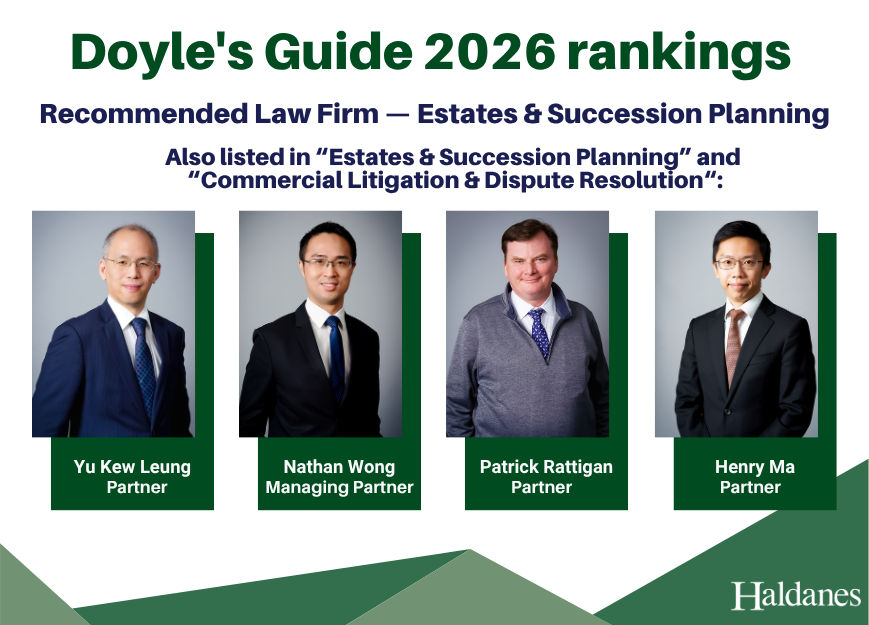
Haldanes’ Civil Litigation & Dispute Resolution team excels in contentious probate matters, including the dispute over inheritance. We are recently recognised in the Benchmark Litigation Asia-Pacific Rankings 2026, and officially listed on the joint panel between the Department of Justice (DoJ) and the Hong Kong Trade Development Council (HKTDC) here for the category of “Commercial Litigation & Cross-border Dispute Resolution”.
 Articles